
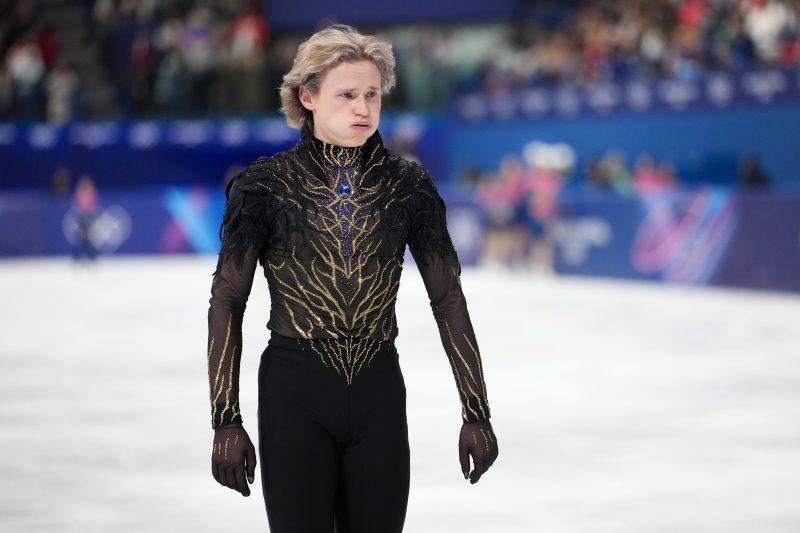
How Ilia Malinin’s Olympic failure is teaching moment for kid athletes
The only true wisdom is in knowing you know nothing.
As Ilia Malinin’s voiceover to his free skate song began, you could see the tension in his face, and the tightness in his performance.
If you are a sports parent, you have probably been there, and the feeling is excruciating.
When you watch your son or daughter perform during a tense game – maybe a district championship or sectional final – you exhale at the end, not so much because of how they did, but because it’s over.
But there was no escape this time for Malinin, or his parents. This was the Olympics, and his routine was just beginning. He stopped short of executing his quads and fell not once, but twice.
We expressed shock and awe at what we were seeing, in the media and elsewhere. The broadcasters and crowd in Milan slipped into stunned, uncomfortable silence.
Malinin, 21, the U.S. and world champion and overwhelming favorite to win the men’s singles free skate, would finish eighth.
But was it really that shocking?
Malinin admitted to Christine Brennan and Brian Boitano, in our Milan Magic podcast leading up to the Olympics, that he starts to feel his nerves around the six-minute warmup before an event. But he had usually been able to get lost in the process, not thinking about medals but getting lost in normalcy of his routine and what he needs to do within it.
Not this time.
‘The pressure of the Olympics really gets you,” Malinin said afterward. “The pressure is unreal. It’s almost like I wasn’t aware of where I was in the program. Usually I have more time and more feeling of how it is, but this time, it all went by so fast, and I really didn’t have time to make those changes or make that process different.”
Think of our own kids. We don’t need to put the weight of expectations on them. Often, they do enough of it themselves, even if they are a picture of confidence leading up to events.
Malinin’s failure was a teaching moment for all of us — young athletes, parents, and otherwise — but it’s not a disaster unless we allow it to be.
“I was a Duke undergrad way back when. And so I still had that mindset of everything has to be perfect,” Aaron Dinin, now a professor at the university who teaches a course called “Learning to Fail,” told USA TODAY Sports late last year.
“You wind up with these kind of weird phrases like, ‘Fail fast’ and ‘embrace failure.’ And I’m like, ‘No, failure stinks. That’s the most ridiculous thing I’ve ever heard.’ It’s not good to fail. It’s just also not bad to fail. It’s just natural.”
Dinin said he intentionally gives students poor mid-semester grades to see how they react.
Here are three steps to consider after our young athletes fail, whether they are Malinin or youth recreational players:
Should we really expect any athlete, even Ilia Malinin, to be successful all the time?
As adolescents, our brains are not fully formed until we are about 25. It just takes a small moment to knock them off course.
‘I blew it,’ Malinin said after his Feb. 13 performance. ‘That’s honestly the first thing that came to my mind, there’s no way that just happened. I was preparing the whole season, I felt so confident with my programs, so confident with everything. That happened, I have no words, honestly.’
Facing up to heavy competition, and expectations, whether from our parents or others, is difficult. Malinin now has the experience of his first Olympics, where he won gold as part of the figure skating team event, under his belt.
After his heart-wrenching singles performance, he was caught on a hot mic talking about how things would have unfolded differently had he gone to the 2022 Beijing Games.
‘Beijing, I would not have skated like that,’ he was heard saying. NBC commentator Johnny Weir told viewers he said he would not have skated so terribly had he already had Olympic experience under his belt.
Now he has it, and he can get better from it if he allows the experience to soak in. The first step is giving ourselves grace to accept what has happened and we’ll get better from it.
We can learn to embrace the hype, but not the negativity
It’s OK to be confident in ourselves, especially when we have put in as much work to get where we are as Malinin or any Olympic athlete.
We can give ourselves, or our teammates, playful nicknames like “Quad God” to help keep things light during our grueling work to get there.
“People should keep in mind that we’re also human beings and we’re not robots,” Malinin told NBC Sports last year. “A couple of my friends who’ve been thrown off by just a few comments, don’t want to skate anymore because they don’t want to deal with that. The strongest ones can go through it, and either suppress it or push it away. But also addressing it is a way to show your power, because you’re owning your own spot in this.”
Malinin said that in responding to critical comments about him at the ISU Challenger Series Lombardia Trophy in Italy.
But why even look at them? Larissa Mills, who directs the London, Ontario-based Mental Game Academy and has worked with thousands of athletes from the youth through professional levels, says we can ‘tank’ our performance if we look at our phones before competing.
‘The brain takes 22 minutes to go back to refocusing,’ Mills told USA TODAY Sports last year. ‘We’ve wasted an inning, a period, a half on poor decision-making skills. So why did you bother? Don’t even go on the ice, as far as I’m concerned.”
Social media can be a crucial tool for young athletes to promote themselves for coaches as they try to reach the next level. But stop there. Instead of scrolling to see what people are saying about you, Mills suggests you come up with a personal mantra that you have in your head when you compete that validates what you have been doing: I am powerful, I am fast, I am strong.
Remember, our kids need our support, even if they’re Ilia Malinin
Malinin’s father, Roman Skorniakov, and mother, Tatiana Malinina, are former Olympians who represented Uzbekistan at two Olympics. Malinin told Brennan and Brian Boitano his parents didn’t want him to go into figure skating because of what it took out of them.
His father’s reaction was gut-wrenching, and it was human. But Ilia will likely see a replay of it, if he already hasn’t.
Now dad’s job is to tell his son that what happened is OK. Our heroes, and our kids, are vulnerable, especially when they’re in their early 20s. Sometimes we just need to tell them what they have already accomplished is extraordinary.
As for what happened Feb. 13, we can follow the words Malinin later says in his free skate song: ‘Embrace the storm. You are something but not nothing. Past is not a chain but a thread; pull it, and it may lead you home.’
A large photo of Malinin hangs on the wall of a skating complex where my nephew plays hockey. He is from our area, Northern Virginia, and has likely inspired thousands of kids.
It’ll be inspiring for them to know he failed, and they can, too
Borelli, aka Coach Steve, has been an editor and writer with USA TODAY since 1999. He spent 10 years coaching his two sons’ baseball and basketball teams. He and his wife, Colleen, are now sports parents for two high schoolers. His Coach Steve column is posted weekly. For his past columns, click here.