
Could Europe withdraw from World Cup over Trump’s Greenland threats?
With the 2026 World Cup just five months away, U.S. President Donald Trump’s continued threats over Greenland have increased the specter of a European boycott.
Talk of UEFA sitting out the World Cup is theoretical for now. No European country has made any kind of commitment to boycott the tournament if Trump actually makes good on his promise to annex Greenland – by negotiation or by force – but the topic is becoming increasingly relevant.
Below we run through the biggest questions surrounding a potential European boycott of the World Cup.
Why would Europe boycott the World Cup?
Trump’s quest to control Greenland has strained already tense relations between the U.S. and Europe.
Greenland is a self-governing territory that is part of Denmark, a member of the North Atlantic Treaty Organization (NATO).
The U.S. is also a member of NATO, a key element of ensuring peace among Western nations since World War II. Article 5 of the North Atlantic Treaty states that an armed attack against one NATO member shall be considered an attack against them all.
Trump has become increasingly explicit over his desire to make Greenland part of the United States, saying on Truth Social during the weekend that he no longer needs to ‘think purely of peace’ when it comes to controlling the world’s largest island.
The president has threatened to impose punitive tariffs on European nations that oppose his demand for Greenland, setting off alarms across the continent.
Greenland and Denmark have both repeated their objections to Trump’s desires, but it’s unclear how much pressure they – and Europe – can withstand.
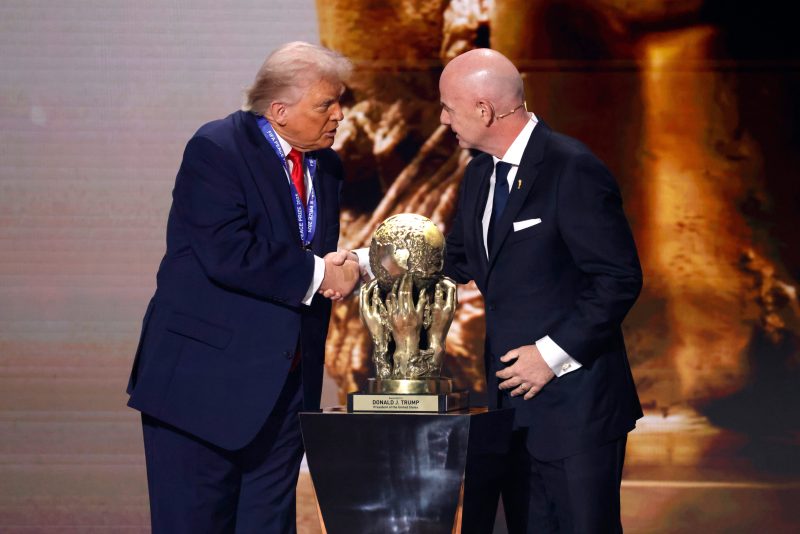
That is where the possibility of a World Cup boycott comes in. Trump has taken center stage in the lead-up to the tournament, which will be held in the United States, Mexico and Canada from June 11 to July 19.
Should UEFA band together and actually reject participation in the World Cup, it would throw the entire tournament into chaos and would be a major embarrassment for Trump and FIFA.
It’s unclear how, or if, the tournament would proceed if UEFA pulled out, given European teams are set to make up 16 of the 48 spots at the World Cup.
What has been said about a World Cup boycott?
European leaders have increasingly been questioned over a World Cup boycott in recent weeks. Most have opted for a cautious approach without ruling out the possibility entirely.
Jürgen Hardt, a member of German parliament and spokesperson for Chancellor Friedrich Merz’s Christian Democratic Union party, told BILD that a boycott would be used ‘as a last resort in order to get Trump to see sense on the Greenland issue.’
‘The question is indeed justified as to whether Europeans should participate in a competition in a country that is indirectly, and possibly soon directly, attacking Europe, don’t you think?’ Göttlich asked.
In the United Kingdom, MPs Simon Hoare and Kate Osborne both told Metro that a boycott should be considered.
‘We should send as many messages as possible to the Trump administration and the American people that there are certain red lines in regards to upholding sovereignty and international affairs,’ Hoare said.
‘If that means not going to the World Cup then we shouldn’t go to the World Cup.’
Osborne added: ‘The USA should not be able to participate in the World Cup, let alone be part of hosting it, so yes I support those calling for a boycott.’
France’s sports minister Marina Ferrari was more cautious this week but also didn’t rule out the potential of a boycott.
‘At the moment we are speaking, there is no desire from the ministry to boycott this major, much-anticipated competition,’ Ferrari told reporters on Tuesday. ‘That said, I am not prejudging what might happen.’
Has there ever been a World Cup boycott?
Countries boycotting the World Cup would not be a new development, though it has not happened in more than a half century.
There have been nine countries – and one entire continent – that have boycotted the World Cup since its first edition in 1930.
The first boycott was Uruguay in 1934. The South Americans won the first World Cup in 1930 but refused to travel to Italy in 1934 to defend their title.
Uruguay also boycotted in 1938 and was joined by Argentina, with both countries refusing to travel to France.
India withdrew in 1950 and in 1958, Turkey, Indonesia, Egypt and Sudan all pulled out of qualifying.
In 1966, all of Africa boycotted the World Cup as a protest against a perceived unfair distribution of World Cup places. Of the 16 World Cup spots that year, FIFA only offered one place to be fought between three continents: Africa, Asia and Oceania.
The most recent boycott came in 1974, when the Soviet Union refused to play Chile in a playoff between European and South American qualifying runners-up.