
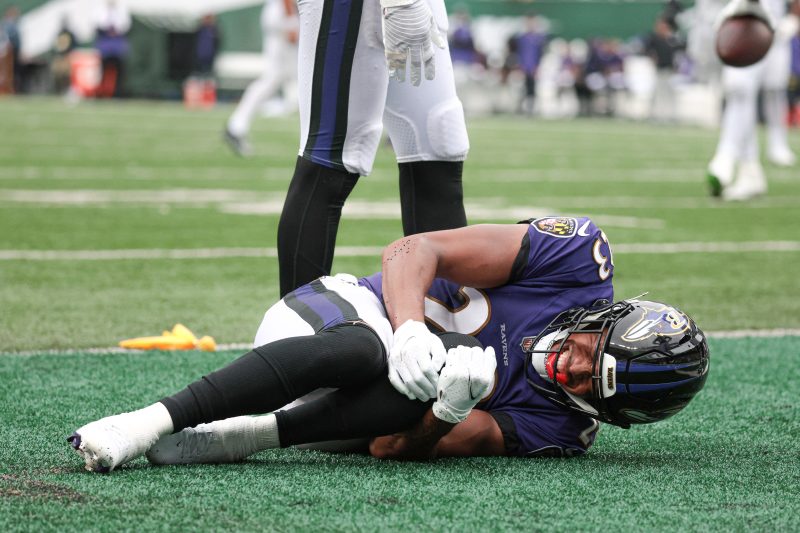
- Half of the NFL’s stadiums use natural grass while the other half use synthetic turf, sparking an ongoing debate about player safety.
- Many NFL players prefer grass, believing it is less taxing on their bodies, but the league maintains data shows no significant difference in injury rates between surfaces.
- Several NFL stadiums with turf will install natural grass to host 2026 FIFA World Cup matches, as required by soccer’s governing body.
- The NFL and NFLPA are working to create consistent standards for all playing surfaces, with a new policy mandating new, approved fields by 2028.
It’s the NFL debate that never goes away.
Grass vs. turf? With the league adopting new playing field standards and seven of its 30 venues pulling up turf to install grass for 2026 World Cup matches, the NFL and its players are still working to find common ground between the end zones.
“Grass is the natural thing. Turf is the unnatural thing,” Dion Dawkins, the All-Pro left tackle for the Buffalo Bills, told USA TODAY Sports. “If you’re playing on grass, there’s a give. It’s a softer bottom. Like there’s dirt, there’s soil, there’s bugs. It’s just a real, live thing.
“Turf, you can scrape yourself and the turf burn is like rubbing your arm on sandpaper. Us big guys, we can plant in the turf to hold defenders back, but sometimes your feet get caught in a little seam. Grass doesn’t do that. Grass will rip up.”
Go ahead, preach this sermon. Exactly half of the NFL’s 30 venues have playing surfaces with all-natural or hybrid grass while the other half roll with synthetic turf.
“Grass is probably more expensive to maintain, which is why any businessman would say I’d rather have turf over grass,” Dawkins continued. “But for the longevity of a player that they may be investing $250 million in, and some of these guys are $500 million players … if it were me, I’d put my players on the best ground to keep your assets alive.”
The other side of the debate contends, turf burn or not, there’s essentially no difference in the injury rate between natural and synthetic surfaces.
Football is a violent, physical game, and injuries are inherent. Yet in considering non-contact, lower-extremity injuries, and concussions that can be linked to the playing surface, the league has for years maintained the data doesn’t show that grass is any safer than turf.
On Dec. 4, when the NFL revealed plans to institute standards for approving playing surfaces – a big step toward the stated goal for consistency – the league’s chief medical adviser, Dr. Allen Sills, doubled down on the turf-is-just-as-safe-as-grass theme.
“If you look at natural grass as one bucket, artificial fields as another bucket, we look at things like overall injuries, or ACL tears, or Achilles ruptures, or concussions,” Sills told reporters during a videoconference. “And if you look at that, you don’t really see what I’d say are statistically significant differences.
“And that’s what we look at in medicine and biology … not just is there a raw difference, but is there something that is statistically meaningfully different? And we also look at it by stadium.”
Dallas Cowboys owner Jerry Jones, whose team plays on “Soft Top Matrix Turf” at AT&T Stadium, firmly agrees with Sills’ conclusion about the injury data. Never mind the feedback from players – often anecdotal but seemingly widespread – who prefer playing on grass largely because it is less taxing on their bodies.
NFL stadiums to switch to grass for 2026 World Cup games
Jones, like other NFL powerbrokers, will switch out the artificial turf for natural grass when AT&T Stadium hosts 2026 FIFA World Cup soccer matches next summer. Add that to the debate.
What’s the rationale for not having grass for Cowboys games, too?
“There’s no difference for safety,” Jones told USA TODAY Sports. “No difference. I put grass in here for the soccer, because that’s the only way they’ll play the game. Not because I think that grass is a better surface.”
While NFL players may overwhelmingly prefer grass, it has never been an issue prominent enough for the NFL Players Association (NFLPA) to take to the negotiating table during labor talks. Sure, there have been bigger issues such as the percentage of revenue that determines a salary cap that has grown to a record $279.2 million per team in 2025, while league revenues have soared in the neighborhood of $25 billion.
Nearly a decade-and-a-half ago, after a lockout in 2011, the NFLPA negotiated for more favorable work rules that essentially eliminated two-a-day practices during training camp and significantly reduced the amount of contact in practices throughout the year.
Yet unlike elite soccer players who refuse to play on anything other than natural grass – hence, seven of the 11 NFL venues that will host World Cup matches, will convert from turf to grass – NFL players have come nowhere near fighting league owners over their preference for grass.
Jones insists that cost isn’t an issue, although he acknowledges that artificial turf allows for much greater flexibility in staging events outside of football at his world-class stadium.
“No. No relationship to that,” Jones said, asked about cost, “or serious injuries, between turf and grass.”
Considering the stadiums that will install grass for the 2026 World Cup, the optics are a bad look for the NFL.
Just think: The World Cup final in July will be staged at an NFL venue, MetLife Stadium, that is notorious for the high-profile injuries that have occurred on its various forms of artificial turf. For the World Cup, though, turf will be out at MetLife, grass will be in.
What’s good for the soccer players should be good for NFL players.
“Not at all,” Jones disagreed. Of the soccer players, he added, “I don’t know if they’re doing it for safety or not.”
Indeed, there are so many variables for the debate. Smoothness and density of the grass surface, which facilitate the roll of the ball and reduce bounce, are key elements for soccer players.
“It’s got to be like a pool table, almost,” John Sorochan, the University of Tennessee professor and NFLPA consultant, told USA TODAY Sports of the expectations for the World Cup pitch.
Sorochan is a leading expert when it comes to turf and field management. He has worked with the NFLPA since 2010 and also consults with FIFA. Decades ago, in researching for the 1994 World Cup, the Michigan State alum spearheaded a major breakthrough by growing grass inside the Pontiac (Michigan) Silverdome.
Interestingly, he praised Jones for the grass installed at AT&T Stadium in 2024 for an international soccer friendly between the Mexico and Canada national teams. The grass was grown indoors for more than a year, with the sod tacked into Geotextile fabric, which covered a “plastic waffle system,” Sorochan described, that facilitated drainage.
“Both teams said it was one of the best surfaces they had ever played on,” Sorochan said. He added that high-tech testing, using a machine called the Flex, confirmed the surface had natural reaction – including the energy flow between players and the surface – similar to that at NFL grass fields such as Arrowhead Stadium and Lincoln Financial Field.
And the grass pitch was strong enough to play rugby (or maybe use the Push Tush) on it.
“There’s nothing more strenuous than a rugby scrum that would make it buckle or rip up,” Sorochan said. “That surface would have held up to that easily. So, you could, in theory, play an NFL game on that, in my opinion.”
Undoubtedly, that surface will be in play when AT&T Stadium hosts nine World Cup matches, including a knockout round semifinal.
“What Jerry Jones has done, he brought grow lights … they’ve got the whole field covered with LED lights growing the grass,” Sorochan said, envisioning the process that will be used after the grass field is transported from a sod farm and installed in the stadium. “So, you can do it.”
Of the NFL’s domed stadiums, there are two – Allegiant Stadium, home of the Las Vegas Raiders; and State Farm Stadium, home of the Arizona Cardinals – that utilize natural grass. In both cases, the stadium designs account for the grass fields to be grown outside the stadium on huge trays, then moved inside for the games.
Yet the debate runs much wider than the viability of growing and/or maintaining grass for use indoors.
Seeking consistency, NFL will raise field standards with new policy
Nick Pappas, the NFL’s field director who oversees the operations, maintenance, research and compliance matters for all of the league’s venues, underscores a bottom-line challenge tied to the grass versus turf conundrum.
“We’ve got essentially 30 different surfaces out there,” Pappas told reporters during the Dec. 4 videoconference. “While 15 may be synthetic turf today, and 15 may be natural grass, the reality is that those 15 natural grass fields vary location to location. They vary throughout the season, and sometimes they vary from one side of the field to the other.”
Pappas went on to mention variables that include artificial turf fields that differ by manufacturer, style and age, and for all surfaces, the differences in climates and types of stadiums, including retractable roof and strictly outdoor venues.
“That makes it really challenging to just say it’s a one-size-fits-all approach, for both natural or synthetic,” Pappas said.
Grass or turf? ‘You can’t get apple juice out of oranges’
That surface variability and its interaction with players and their gear, the NFL’s Sills argues, is more important for the league to address from a player safety standpoint than a field’s natural or synthetic origin.
“I almost think it’s the wrong question to ask … and I don’t mean that flippantly,” Sills said. “What we need to do from a science, medicine, biology standpoint, we’ve got to go back to those parameters that we can now measure.”
Sills pointed to advanced tools that provide more data on traction, hardness and other biophysical properties of surfaces, allowing better understanding of the correlation to injuries.
“The surface is only one driver of these lower-extremity injuries,” he added. “There are a lot of other factors, including player load, previous history, fatigue, positional adaptability, and cleats that are worn. So, the surfaces are a component, but it is a complex equation.”
Sills and other league officials maintain that the primary goal, in conjunction with the NFLPA, is to improve consistency. That’s the thinking behind the upcoming standards that will govern NFL playing fields, with the model resembling the overhaul in recent years that analyzed NFL helmets and banned head gear deemed as less safe. The policy will essentially mandate that each NFL venue will have a new surface by 2028, with teams mandated to choose from a menu of approved fields.
While the policy applies to grass surfaces, too, it might fuel suspicion that the league wants to swing sentiment that favors the use of artificial turf fields. Remember, despite the involvement of league and union officials on a joint surfaces committee, the NFL is adamant in expressing that data shows no significant injury risk from playing on turf while the NFLPA routinely raises questions to the contrary.
“While our player members have been clear about their overwhelming preference for high-quality, grass surfaces, we’re encouraged that their demands for more consistent and safer fields across the board are taking a step in the right direction,” the NFLPA said in a statement provided to USA TODAY Sports. “We look forward to continuing this work with the NFL on behalf of our player members.”
Sorochan, a member of the NFL-NFLPA joint committee, said that much of the committee’s research has focused on artificial turf with an aim to improve safety. He said the decision to remove the turf at MetLife Stadium that used Slit Film fibers, replacing it with a surface made Monofilament fibers, represented progress.
“Low-hanging fruit to hopefully improve things,” he said.
Yet he also expressed pessimism when considering that none of the synthetic surfaces have resulted in reduced injury rates since the NFL and NFLPA began monitoring non-contact, lower-extremity injuries in 2012.
“I’ve been doing research on it since 2010, and we can’t get it to play like grass,” Sorochan said. “It’s not grass. You can’t get apple juice out of oranges. They’re two completely different systems. And while we can try to get them better, it’s not natural grass.”
What happened in Pittsburgh?
Of course, natural grass can have its own issues. While the gold standard may be the hybrid bluegrass, known as SISGrass, used at Lambeau Field – heated by 14 miles of glycol tubing underneath the surface and boosted by grow lights used above the field – a situation at Acrisure Stadium in Pittsburgh in Week 6 cast light on inconsistencies.
The field was a mess when the Steelers hosted the Cleveland Browns a day after the University of Pittsburgh trounced Boston College in October. It was the most egregious issue involving a field surface thus far in the NFL season, and underscored twists that can arise in sharing a venue (in addition to Pitt games, Acrisure Stadium was also the site in recent weeks for multiple high school playoff games).
The Steelers already had planned for a typical full-field re-sodding in October. Yet before playing on a shoddy field, apparently stuck to the original replacement timeline.
Sorochan wasn’t on site in Pittsburgh, but contended that the field experts on hand for the team didn’t have the power to dictate an earlier re-sodding. He said the field passed the inspection that measured hardness, but the problems stemmed from a lack of traction and softness in spots. Standards for traction apparently are expected to be included in NFL surface protocols next year.
“Sometimes, things fall through the cracks,” Sorochan said. “They didn’t expect that field to perform as badly as it did. Moving forward I think they would probably say, ‘Let’s replace it before this.’ (But) the person who is leading the grounds crew and is on it every day should be empowered to make that decision.”
He maintained that with some teams, and as an example he named Tony Leonard, the Philadelphia Eagles vice president for grounds, it would have been handled differently. “Tony would say it,” Sorochan said, “and it would happen.”
Nonetheless, the surface at Acrisure Stadium appeared to be in pristine condition when the Steelers hosted the Buffalo Bills on Nov. 30 – a day after Pitt was trounced there by Miami (Fla). The sod was replaced twice in November, between the numbers earlier in the month and then a full-field re-sod on Nov. 23.
NFL players’ grass preference is widespread, not universal
Still, even with challenges that can come with weather, usage and other variables, you won’t find many players who’d rather play on artificial surfaces. Of course, there are nuances with that.
New Orleans Saints linebacker Demario Davis, a 14th-year NFL veteran, isn’t so passionate about the need to play all of the games on natural grass.
Asked about the impact on his body after playing a game on turf, when compared to grass, he told USA TODAY Sports: “I play linebacker, man. I feel a lot more of the hits than I do what surface I was running on.”
Still, Davis, who serves as his team’s NFLPA representative, said the bigger concern is what happens when fields – natural grass or artificial turf – are found to be in faulty condition.
“How can we make sure we get those changed immediately?” said Davis, whose home games at the Mecedes-Benz Superdome are played on a synthetic surface identified as Turf Nation-M6. “But as far as the whole league being grass or the whole league being turf, I don’t have a preference. Just as long as we play in safe environments.”
One thing for sure. The debate will rage on.
“I’m a big fan of grass,” Indianapolis Colts receiver Michael Pittman told USA TODAY Sports. “I just think when you look at FIFA and how when these teams come over here, they put grass over turf, maybe we can do the same thing in the NFL.”
Then again, it may not happen in the NFL until – or unless – the debate becomes important enough for players to make it an essential demand in labor negotiations.
Contact Jarrett Bell at jbell@usatoday.com or follow on X: @JarrettBell