
How to fix the CFP and strengthen college football: No more charity
- A proposed 16-team playoff would eliminate automatic qualifiers for conferences and special access for Notre Dame.
- The selection committee should consist of former coaches and media members, removing athletic directors to avoid bias.
They’ve been arguing about the new College Football Playoff format for nearly a year, bickering back and forth about a bunch of something that really means nothing.
It’s time for the Big Ten and SEC to straighten out the college football postseason mess by simplifying it: Eat what you kill.
No more automatic qualifiers.
No more gifts to the four Power conferences, no more ‘excuse me’ entry for the Group of Six. It’s 16 teams with a selection committee of former coaches and media members, and every single invitation is based on merit.
Not on conference affiliation or charity.
No more athletic directors on the selection committee with obvious biases and inherent investment in one program or another. No more random Jane and Joes off the street to give the committee an everyman feel.
I want people who know ball ― and media members keeping coaches from their inherent investment ― and understand the nuances of the game, and aren’t tied to some funky formula of not being able to vote one team over another because the two teams were never in the same quartile to vote on. Or whatever the hell the current committee tried to sell about Notre Dame and Miami.
You can’t be told one thing by the committee for four weeks — that head-to-head didn’t matter — then be told the exact opposite on the final poll.
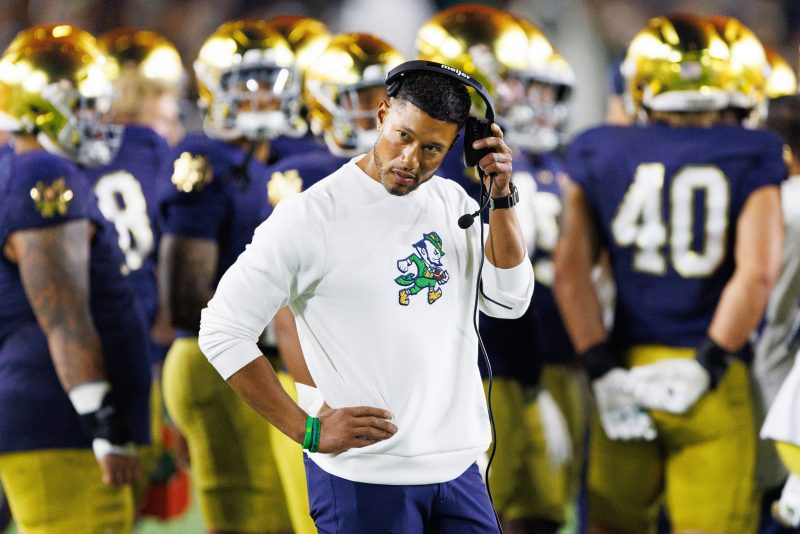
That doesn’t mean the Irish should’ve pulled a temper tantrum and walked away from the bowl season, but it certainly means we have to take a long look at how this thing works and how simply it can be fixed. No matter how Notre Dame and the Group of Six push for access.
The current memorandum of understanding for the new CFP contract beginning with the 2026 season gives Notre Dame automatic access if it is ranked in the Top 12. And, of course, an automatic access for the highest-ranked Group of Six conference champion.
It’s an MOU, it’s not legally set in stone.
Ladies and gentlemen, I’m here to tell you the days of pandering to Notre Dame are over. Same with the Group of Six.
There’s a bit of a hiccup with the Group of Six, because they may start talking about legal action and antitrust laws. But there’s an easy way around it: pay them off.
Give them more cash from the new 16-team CFP format (which will earn significantly more money than the $1.4 billion annually it does now), and give them the same guarantee as everyone else. If you finish ranked in the top 16, you’re in the CFP.
If you don’t, better luck next year.
Remember this, everyone: the Big Ten and SEC have the ultimate trump card. If they don’t like the way this thing is set up, they can walk away and have their own playoff — and there’s nothing any enterprising attorney can do about it.
Then what does the Group of Six have? Bupkis.
And Notre Dame? Same deal: If you finish in the Top 16, you’re in the playoff. No more bending over for the university with its own television contract.
For years, the Big Ten and SEC didn’t want to rock the Notre Dame boat — just in case the Irish decided to join a conference. The two super-conferences of the sport kept winking at Notre Dame, and allowing this nonsensical favorable entry into the BCS/CFP.
Not anymore. The idea Notre Dame is a television draw certainly holds merit, but not nearly as much as it once did. Decades ago, Notre Dame dominated the television landscape and built a significant following because of it.
Now every game — every single FBS game — is televised one way or another. It’s a fall smorgasbord of football every Saturday, and every other day except Sunday.
Notre Dame isn’t the draw it once was. The Top 10 teams in viewership this season, according to Nielsen, were all SEC and Big Ten teams.
Last year, when Notre Dame advanced to the CFP championship — and pocketed $20 million because of the sweet deal given to it by the CFP — its game against Ohio State drew 22.1 million viewers. It was one of the lowest viewership numbers in the history of BCS/CFP championship games.
How low, you ask? The fifth-least watched game of the BCS/CFP era.
That’s not narrative or Notre Dame hate, those are facts. There’s no reason to kowtow to Notre Dame other than the Big Ten and SEC hoping the Irish will come to its conference senses and choose them.
They won’t. It would be fiscally reckless for Notre Dame to do so — to say nothing of its outright steadfast determination to remain an independent.
And that’s fine. Just like it’s fine for the Group of Six to decide they’ll take their chances and threaten legal action, and not think the Big Ten and SEC will walk away from the entire process.
You’re not preventing Notre Dame and the Group of Six from playing in the CFP, they’ll have the same access as everyone else. You want to expand the CFP beyond 16? Go ahead, just don’t change the foundation of the new deal.
Eat what you kill.